A Simple Mussar Technique

There are infinite facets to Torah and we have complex relationships with it.  Ideally, we’re supposed to use Torah in order to better and refine the world, both Olam Gadol, the macrocosm of the universe and Olam Katan, the microcosm, also known as Man.  Ideally, when we work on one we simultaneously benefit the other.

While it trivializes Torah, which means much more than our book of historical and ethical heritage, to turn Torah into a self-help, pop-psychology gimmick, Torah does, indeed, have the power to help us refine and strengthen ourselves.

All of us have our challenges, our yetzer harah, urges towards evil.  (In fact, learning to resist its call is one of our greatest spiritual opportunities, as well as challenges, as it gives equal weight to both options facing us at any one time, insuring that we truly do have Bechirah, “free” will.)  Almost all of us have an array of self-destructive appetites in one arena or another, ranging from addiction through compulsion through everyday desire.  They’re most often observed in the realms of food and sex, both realms of sensual pleasure, but can also manifest in power/control issues as well as others.  They are rarely easy to permanently overcome and each combination of person/appetite requires a different level and approach of response in order to transform them into non-negative forms.

This isn’t a comprehensive, fix-all technique, but it can be effective.  Other than possibly allowing disappointment when it’s not immediately “fulfilled”, I don’t think it can bring real harm.

When I have the presence of mind, the first thing I try to ask myself when I find myself drawn into a self-destructive pleasure (my biggest enemy, by the way, is carbohydrates which I very well know act like poison in my metabolism) is if I really believe that The Creator is powerless to present, presumably in a safe, healthy and growth-ful manner, the pleasure I think I need to provide myself in a less healthy way?

Ultimately, like in so much of our lives, it comes to faith.  And shifting our reliance from our often-inflated egos to God.

Posted in Uncategorized | Leave a comment

Objective Versus Relative Truth

The previous article, discussing the absurd, yet effective inversion of history by Dotan and Abiram, raises the contemporary issue of narratives and how to evaluate them.

Our tradition, actually, provides a set of straightforward techniques to verify/generate statements that, to borrow a term from symbolic logic, have a positive truth valueOnly if a statement satisfies these criteria it is true.

The first, and most powerful/convincing is verifiable experience/observation.  The template for this is the mass, public experience of Sinai, where a large population not only shares experience, but then transmits it in an unbroken chain.  Talmudic tradition reinforces this, as in numerous examples of first-hand testimony of Temple practices, witnessed by that generation that formed the bridge from the final days  before and during the Temple’s destruction to the beginning of the Mishnaic process.  It also reinforces this principle through the frequent application of the technique, Rabbi X says in the name of Rabbi Y who says in the name of Rabbi Z……. (although there is also a deeper spiritual motivation behind this form of statement, namely to continue elevating the soul of those who thus added to the stream of Torah).

Then there are a limited number of logical operations, well-known and simple to apply, while immensely powerful in scope, to generate new true facts from what is previously known.  They are encapsulated in the famous Thirteen Principles of Rabbi Ishmael, part of the daily morning liturgy (a reminder/warm-up of how to be objective as each new day’s experiences open).  (There is a profound and unexpected relationship between these intellectual techniques and the Thirteen Principles of Divine Mercy, but that’s for another discussion.)

Although not necessarily a popular position in contemporary society, our tradition insists that not all narratives are equal.  Of course, one can say anything, but that statement, or set of statements or narrative, is true only if it meets one of the above criteria. Otherwise, it has the status of 2+2=3 and must be rejected.

Posted in Uncategorized | Leave a comment

Eternally True For Every Generation

Until the most recent years, I was always baffled by Dotan and Abiram in the upcoming weekly Torah selection, Parshat Korach.  Why bother with their nonsense?  Did they really think anyone would take their “arguments” against Moshe seriously?

יג הַמְעַט כִּי הֶעֱלִיתָנוּ מֵאֶרֶץ זָבַת חָלָב וּדְבַשׁ לַהֲמִיתֵנוּ בַּמִּדְבָּר כִּי־תִשְׂתָּרֵר עָלֵינוּ גַּם־הִשְׂתָּרֵר:         יד אַף לֹא אֶל־אֶרֶץ זָבַת חָלָב וּדְבַשׁ הֲבִיאֹתָנוּ וַתִּתֶּן־לָנוּ נַחֲלַת שָׂדֶה וָכָרֶם הַעֵינֵי הָאֲנָשִׁים הָהֵם תְּנַקֵּר            לֹא נַעֲלֶה                                        במדבר ט”ז:יג-יד

13  Is it a small thing that you have brought us out of a land that flows with milk and honey, to kill us in the wilderness, that you also make yourself a prince over us?                14  Moreover you have not brought us into a land that flows with milk and honey, or given us inheritance of fields and vineyards. Will you take out the eyes of these men? We will not come up.            (BaMidbar 16:13-14)

The blatant inversion of reality seemed absolutely irrational and my question always, even as a child, has been why would they have bothered to say something so absurd and why would the Torah have reported it?

Trying to avoid politics by refraining from opining on the merits or otherwise of the Palestinian claims for statehood, one can’t avoid seeing the almost identical inversion of history and reversal of roles that appears daily in much of their public statements.  Who, American or European, Jewish or Christian, whether a supporter of a Palestinian State or one who feels they have no legitimate claim, believes that there was never a Jewish Temple in Jerusalem, that our biblical ancestors never dwelled on this land, that Jesus was a Palestinian martyr, that there is a secret program of ethnic cleansing paralleling the Holocaust (which, of course, is itself denied)?  Who can miss the obvious usurpation of Jewish history, not only recorded in the Torah/Bible, but also by pre-Christian Roman historians as well as modern historians of World War II?  There are people alive today who either experienced or witnessed the more recent of these events.

The sad answer is that increasing numbers of people around the world are coming to believe these fantasies.  News stories daily report this bizarre phenomenon throughout Europe, spreading in the US and Latin America, becoming accepted as, forgive the ironic turn of phrase, gospel, in Academia.

And finally, after millennia, the story of Dotan and Abiram is all too starkly believable.

Yes, I bemoan and protest this sad state of affairs, but much more than that I realize the Bracha, yes, the blessing, in experiencing the actual flowering of a previously closed chapter of Torah.  Perhaps every generation does have the opportunity to see a brand new facet of Torah revealed and this is merely ours.  Or perhaps we, all of us, Jew and non-Jew alike, are, indeed, a generation of very special Neshamot, souls, ,living in a special time of special crises, needing and receiving the exact light required for our holy contribution to Tikkun Olam, the complete rectification and reharmonization of the world.  With a great gift, remember, always comes a great responsibility.

Posted in Uncategorized | Tagged , , , , , , , , , , | Leave a comment

More Thoughts On Mitzvot

While it makes sense that, as finite beings, we can’t fully observe or understand the infinite levels, effects and implications of mitzvot, each of which are elements of the Infinite Torah, garments, as it were, of the Infinite God, we can be aware and can acknowledge that mitzvot are, indeed, infinite.  Some mitzvot have, among their array of effects, more impact in the world we do have access to, including the realms of the physical, emotional, mental or that tiny slice of the spiritual we can perceive.  Others have so much more impact in realms so far beyond our senses that it becomes difficult to apprehend, and easy to forget, that they also impact our material world.

Therefore, it’s important to keep in mind that even if the physical world were “perfected”, were all our crises, be they environmental, social, political, health, individual fulfillment “solved” we would still want to continue our commitments in order to continue improvements and refinements in the worlds beyond our grasp.  Likewise, if we only aim our mitzvot at the “spiritual”, foolishly thinking that the worldly is somehow trivial, we’ll guarantee we never reach those goals either because we will have neglected the more fundamental levels.  Just because we can never understand more than a limited sets of interactions with the world (of which we also only perceive a very limited portion) doesn’t mean that these are the only points of intersection.

Perhaps it’s a useful image to view individual mitzvot, as we engage them, as lines, as described by geometry, extending infinitely in both directions, penetrating to the depths of our material world and extending to the infinite heights of the unseeable, extending even beyond the boundaries of Sulam Yaakov, the famous ladder of Jacob’s dream (it only approached the ground, but when we begin to mount it, we do, in fact, provide the rest of the path into the material world).

I think all of us, from time to time, regardless of our involvement and commitment to mitzvot, resent their constant presence, their intrusiveness into every moment.  It’s easy to wonder why, in our daily liturgy, we thank and bless The Creator for obligating us to all these commandments.  We need to remember, though, that they continuously challenge and encourage us to extend ourselves as far as we can go, to the heights of spirit and to the deepest engagement with the mundane.  They allow us to be all that we can be, often in spite of ourselves.

Posted in Uncategorized | 1 Comment

More Thoughts on Middot

                    וְכָל מַעֲשֵׂהוּ בֶּאֱמוּנָה      And all of His acts are with Emunah (faith/faithfulness)             (Shabbat/Festival morning liturgy)

                 קְדשִׁים תִּהְיוּ כִּי קָדוֹשׁ אֲנִי      Be holy because I am holy….                                                   (ויקרא יט:ב/Vayikra 19:2)

Jewish tradition refers to מדות, Middot, frequently.  It’s simplest meaning is a measurement or a quality. It’s also used to refer to character traits and often identified with the Sefirot, the system that arranges and describes, as much as possible, the path that transcendental/Divine energy enters our material world.  In the field of Mussar, a systematic approach to refining our deepest selves, they also refer to character traits, although not necessarily identical to those reflecting the Sefirot.  One of the most important of these is אמונה, Emunah, usually inadequately translated as belief or faith. (For a more detailed discussion of Emunah itself,  please refer to my prior lesson on it).

Closeness in the realm of spirituality is defined by similarity rather than by geometry.  In our goals to approach and eventually join as fully as we’re capable with The Creator, we move towards Him by imitating his actions as they are revealed to us in this world.  The Torah hints at this with the above citation,  קְדשִׁים תִּהְיוּ כִּי קָדוֹשׁ אֲנִי, Kodesh Ti’hyu Ki Kodesh Ani, Be holy because I am holy….(ויקרא יט:ב/Vayikra 19:2).  Beyond whatever social or personal benefits there may be to our conducting ourselves in as holy (קודש, Kodesh, is a very difficult word to simply define.  It’s used not only to mean holy, but also separate and even to refer to a prostitute!) a manner as possible, we’re explicitly instructed to be holy in order to be and act similarly to God!

Emunah is another quality we want to incorporate into our lives and we’re also told, וְכָל מַעֲשֵׂהוּ בֶּאֱמוּנָה, V’Chol Ma’aseihu Be’Emunah, and all of His acts are with Emunah, that emunah is yet another quality of The Creator.  Here we’re presented with an additional dimension in which to approach and join God.

The daily morning liturgy includes a section of the thirteen hermeneutical principles with which to decode and examine the Written Torah.  They are actually labelled as מדות, Middot, as well.  Our tradition tells us that these thirteen middot are identical, but in the intellectual plane, with the thirteen principles, again middot, of Divine Mercy!

All of this points to the concept that the middot are not arbitrary nor are they merely attractive personality traits.  Each of them can be said to be a distinct channel with which to carry on our dialogue with God.  They are non-mutually-exclusive paths which can, and should, be employed simultaneously in our journey towards דבקות, Devekut, attachment to and merging with the Infinite God.

Posted in Uncategorized | Leave a comment

How?

A number of readers who have enjoyed the articles recently appearing on this blog have said to me, “It’s all well and good to try to make all moments, not just those engaged in ritual, holy.  But how, Rabbi, do I accomplish that?”

My lack of detailed instructions is neither an oversight nor a cop-out.  The fact is that there is no universal, “one size fits all” path.  Each of us has to discover their own, and that in itself is an ongoing life-process.

There really are a small number of true Tzaddikim out there who have developed the access to more deeply seeing into our souls, and if you’re lucky, truly blessed, to find a genuine one, you may be able to reach insights to this at a very deep level.  But as for me, I don’t know each of you well enough to even offer specific suggestions (I’m only slowly discovering myself).  I’m always open to private discussion, and perhaps I can offer some more general suggestions and guidance the better I get to know you, but if I try to make pronouncements right off the bat, I’m almost guaranteed to be wrong.

I support and applaud all of our efforts at self-discovery and self-refinement.  It’s not easy, it will always be a work-in-progress and we’ll all stumble and mistakes along the way.  The important thing, as I can see it, is to remember that The Creator, with all His heart, desires nothing more than each of our successes.  Part of that success, however, requires each of us to work it out, of course with guidance, for ourselves.

We’re all more capable than we might fear, less accomplished than we might think.  Let’s enjoy the journey together.

Posted in Uncategorized | Leave a comment

Making It Real

Every worthwhile goal is both approachable and unreachable.  Ponder that for a moment and apply it to your goals.

Our paradigmatic goal in Judaism, and probably all spiritual traditions, is to as closely as possible join ourselves with The Creator.  Our tradition emphasizes that God’s reality is infinite dimensions beyond our comprehension.  As vastly infinite as is the Torah in all it’s levels of understanding and engagement, God’s true reality is a totally different order of infinity and He is ultimately unreachable.  Nonetheless, we’ve been gifted a set of detailed instructions to bring us ever closer to that aspect of Him that He makes available (and no matter how infinitesimal a portion of that greater infinity that might be, from our human perspective it is Infinite).

A worthwhile approach, and a goal in itself, is to bring holiness, which largely means becoming aware of the holiness that is already there, into every conscious moment.  The comprehensive world of mitzvot are designed as a tool to reach for this.  The reason that halachot are provided for almost every waking moment, from how we get out of bed until we retire at the end of the day is as if to say, “You can connect with God every moment of every day.  If you want to try that at this moment, here’s a suggested method geared exactly to this minute.”  In other words the web of halacha which, from the outside, can seem intrusive and coercive, rather is to present us at all times with an up-to-the-moment “route” to our goal.

The danger inherent in this approach is that it’s too easy to err and think that these mitzvot are the only paths to our goal.  There is another trap which, because of the number of available daily, weekly and yearly mitzvot, is fooled into thinking that even mechanical and rote performances of these mitzvot is all that is required.

Ideally, when a mitzva is optimally performed it brings with it a conscious awareness of God’s presence.  Since, optimally, kavana, intention is actually the most important component in “bringing our selves to the table” for our active relationship with The Infinite, rote performance is not enough.  Additionally, being constantly involved with fulfilling mitzvot is not the same as being continuously engaged.  Even with the greatest kavana when we’re filling a mitzva, there are empty spaces in between each one, and these also, perhaps even more than during “mitzva time” need to filled with the Infinite Light.

Mitzvot are, indeed, important.  In the jargon of logic, they are necessary.  However, even optimally performed with the highest kavana and love and awareness (I’m translating יראה, Yirah, often translated as fear, but better as awe, and even better, relying on the root of the word, ראה, re’eh, which means “to see”, awareness.) they’re not sufficient in themselves.

In addition to, and not substituting for, the mitzvot, we need to train ourselves to recognize God in each moment and each corner of Creation.  When we view at a beautiful landscape, we want to see, beyond the inherent beauty (and perhaps the cause of that beauty), the living presence of God who continuously gives life energy for that view to exist and to ourselves to be able to see it.  We want to see God in every person we meet as well as in ourselves.  We also need to see God in every tragedy, pain, illness and injustice, perhaps at least by acknowledging that those events transcend our understanding of them in their full implications.  (In fact, we have a halacha that we’re mandated to bless the bad that befalls us exactly as we do the good–it all comes from beyond us and beyond our comprehension.)

Mitzvot and Torah study can give us a start and a technique to develop this awareness, but we need to work out for ourselves, each of us as a unique individual, how to take those consciousness results into the rest of our lives.  It’s a challenge that can, at times, seem too hard, and we acknowledge that ultimately we will fail.  But in failing to completely reach this goal we will still approach it as much as we’re able.  We’ll at least partially succeed to a much higher degree than otherwise.

There is a phenomenon in analytical geometry of the asymptote.  Certain curves will infinitely approach a boundary, always cutting the distance but never quite getting there.  This model pretty well describes our spiritual goals.  It’s also described in a Mishna in Avot (2:21), “.לֹא עָלֶיךָ הַמְּלָאכָה לִגְמוֹר, וְלֹא אַתָּה בֶן חוֹרִין לִבָּטֵל מִמֶּנָּה…”, “We’re not expected to complete the work, but we’re not empowered to shirk the effort.”  Rather than stating it in such legalistic, even if we don’t (and can’t) take every step, each one we do take brings us closer.  This applies to those steps which are mitzvot just as much as it does to other steps we take that might be parallel to, but not included in, the mitzva system.

מתן תורה, Matan Torah, the revelation of Torah which we re-experience every year on Shavuot, provided us with a direct experience of total awareness of God, even before we were given the “roadmap” to recreate that spiritual moment forward.  ימין ושמאל, Yamin U’Smole, Right and Left, we need both the mitzvot and the a-halachic systems going full-out, each of us according to the needs and mandates of our individual, unique neshamot.
Posted in Uncategorized | Leave a comment

Emunah אמונה (Faith/Belief)

This is another of the series of Mussar workshops I assist with.  It’s especially timely as we look forward to Shavuot.  Frankly, without the belief that the Torah is, literally, infinitely more than a tribal history and set of rules, I find no reason to value it.  With this belief instead, that the Torah is, literally, the garment that enclothes God, and, as such, the way we can grasp Him (you embrace the king by embracing his robes), it is a vigorous,  sometimes challenging, but effective path to join our limited selves to the Infinite Universe.  Thus we celebrate receiving it.

Mussar Midot and Mitzvot

אמונה  Emunah (Faith/Belief)

(אָנֹכִי יְהוָֹה אֱלֹהֶיךָ……  (שמות כ:ב

I am HaShem, your God….    (Shemot 20:2)

 וַהֲלַכְתֶּם עִמִּי קֶרִי…….וְהָלַכְתִּי אַף־אֲנִי עִמָּכֶם בְּקֶרִי

(ויקרא כ”ו:כ”ג-כ”ד)

And if you deal capriciously with me… I will deal capriciously with you                        (Vayikra 26:23-24)

*   *   *   *   *

I suspect that most atheists have fewer problems with the idea of a Creator/First-Cause than they do with the idea of a Being actively involved with our daily lives and the ongoing maintenance of our universe.  The retired, absent or deceased “clockmaker” doesn’t necessarily violate anyone’s sense of total independence with “arbitrary” ethics and rules.  The concept of an engaged being, higher on the totem pole, as it were, than Man, however, mandates a revised view of ourselves.  It’s hard to give up the conceit of ourselves being the ultimate authority.  Mitzvot are directed to help us reach our own greatest potential, and it seems paradoxical that being commanded to face our own limitations actually maximizes our potential for freedom and potential!

The first of the Ten Commandment, when read superficially, seems to contain absolutely no commandment at all.  It’s merely a declaration that Anochi is God without beginning to define the nature of God other than having the ability and track record of taking us out of the slavery of Egypt.  Nonetheless, while most classical commentators even emphasize the apparent lack of mandate here, they all agree that it does mandate that we יאמין וידע, ya’amin v’yeda, that we “believe and know” that there is a God who, at the very least, brought all that exists into existence.  Both the Rambam, our pre-eminent rationalist, and the Ramchal, our pre-eminent modern kabbalist, begin their most popular books giving us the obligation to “believe and know”.

אמונה, Emunah, belief, is related to the words אומן, Uman, craftsman and אומנות, Omanut, craft.  Whatever we mean by faith/belief, we acknowledge that it requires a lifetime of crafting, that it is always a work-in-progress.  Judaism totally reject the idea of “blind faith”.  Without quite defining what we mean by belief, both of these sages connect this with ידיעה, Yediya, the knowledge of interaction and relationship.  In other words, this mitzva requires us to struggle to develop an ever-growing awareness that there is a Being who exceeds us in, at the very least, the ability to create something from nothing.

The second mitzva is a subset of the commandment to observe, in general, both commandments which seem logical (מצות–mitzvot) and those that appear utterly arbitrary (חוקים–chokim).  Rabbi Shloime Twerski zt”l, explained that the word בְּקֶרִי, b’keri, “capriciously” is related to and implies the word במקרה, b’mikra, which means arbitrarily, without any sense of causation or consequence.  If we act as if all of life is random, God will make it appear just that way to us.  In other words, if we reject our mandate to craft an awareness of God, not just as an absent clockmaker but as an active participant who guides the world with order and direction and purpose, it will increasingly seem that way to us and the journey back from isolation and alienation will grow increasingly far and difficult.  We might start off thinking that we’re the supreme masters, in complete control, but as we persist we’ll experience “the wheels falling off” and the terror of total powerlessness.  Only randomness will reign supreme.

Thus, following the chokim, those commandments without explanation, as well as the mitzvot, those which seem logical (although there is an important principle that for every reason given for a particular mitzvah, ten are concealed), we free ourselves from our ego-driven artificial sense of control, allowing ourselves to approach the Infinite and joining ourselves to Him, transcend our own boundaries.

Posted in Uncategorized | 2 Comments

A Path To The Spiritual

The period between Pesach and Shavuot makes everyone into an expert on the Sefirot. While these terms are too often casually and facilely tossed about, this system certainly can be useful to organize a program of analysis and refinement of our personalities as well as a visual guide for meditation.

However, it also illustrates deep spiritual realities to provide insights that might not otherwise be apparent.

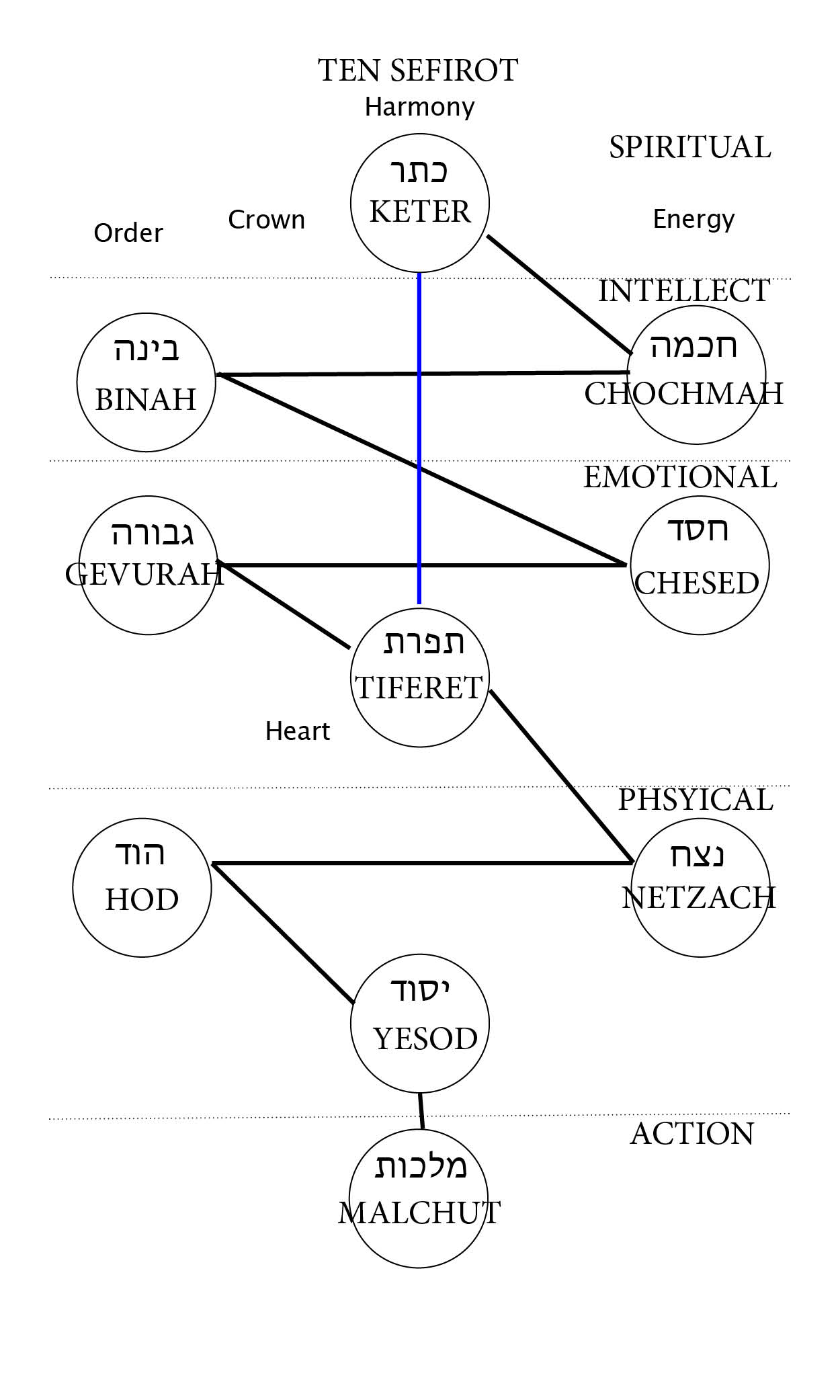
Simplified Ten Sefirot English(I simplified the above chart to group the Sefirot to only show the division of our personalities (spiritual, intellectual, emotional, physical and action), the three columns (energy, order and balance) of function and the normal energetic pathway of process (Keter>Chochmah>Binah>Chesed>Gevurah>Tiferet>Netzach>Hod>Yesod>Malchut and back up again) with a special emphasis on Keter, which represents the transcendent spiritual, and Tiferet, which represents the balanced heart and the direct pathway between these two.)

Although we often long for spiritual experiences and connections, we usually have no idea how to create them or, often, even how to recognize one.  It’s all too common to confuse intense emotional experiences with “spiritual” ones when they really aren’t, just as we too-often over-intellectualize and over-analyze what we think we’re looking for, effectively blocking them completely!

This chart provides a simple, yet much-deeper than expected, insight to this challenge.  כתר, Keter, The Crown, sits above and surrounds the head, but is not part of the head.  It transcends the intellect and, as such, is not directly accessible through the intellect.  It represents the closest contact we have with the spiritual.  The first direct connection (represented by the blue vertical line in the chart) to Keter, along the central pillar of balance and harmony, we meet is תפארת, Tiferet, beauty and balance and the heart-space.  The very simple lesson is that the direct path to the spirit goes through the heart.

This is a deceptively simple observation which can easily be confused with saying, “follow your heart’s desires”.  But it’s not really so straightforward since our hearts desire all sorts of things, both healthy and good as well as evil and toxic.  One of the most central sections of our daily prayers, the Shema, tells us to serve God בכל לבבך, B’chol L’vavv’cha, which because of the doubled “ב” translates as “with all of both of your hearts”, referring to the twin instincts יצר הטוב, Yetzer HaTov, and יצר הרע, Yetzer HaRah, our creative/altruistic instincts as well as our selfish and destructive ones. Before trying to “ride” our heart into the realm of true spirit, we need to first purify our hearts.

For that, we need to follow the energetic path described by the Sefirot chart, processing our thoughts and inspirations through our intellect (Chochmah) and then our analytical abilities (Binah) to our emotional drive to give (Chesed, first organized with structure (Gevurah), to a balanced center (Tiferet) which we call our heart.  The energy continues its path until it results in actions in this world of מלכות (Malchut, “Kingship” also known as שכינה, Shechina, the feminine Divine Presence in our material world), and then returning the resultant energy back through the same pathway, eventually conditioning our hearts with both wisdom and experience.  At this point, with much work, we can achieve a sufficiently pure heart as to allow us to enter the realm of כתר , Keter, the spiritual.

This journey is largely a matter of self-discovery and self-improvement, of continual openness and learning.  But once we are actively engaged in this pursuit the realm of the truly spiritual begins to open to us.  These insights aren’t sufficient in themselves, but they do put us on a viable path to experience our true spirituality.

Posted in Uncategorized | Leave a comment

A Case For Yom Yerushalayim

Yom Yerushalayim (the holy day in 1967 that Jerusalem was liberated from Jordanian occupation and returned to Jewish sovereignty for the first time in almost 2,000 years) should be celebrated across the entire religious spectrum with, at least, a full reading of Hallel (a prayer of thanksgiving, composed of a selection of Psalms, read on certain holy days including the three festivals, Rosh Chodesh (the new month) and Chanukah (when we previously liberated and rededicated the Holy Temple)), with a brahca (indicating the strongest expression of acknowledgement)!

Doing so connects this miracle to God.  Not doing so relegates this to a mere military victory.  Connecting our renewed relationship with Jerusalem, especially Har HaBayit, the Temple Mount, with the Eternal God underlines and eternalizes this relationship.  The refusal in parts of the religious spectrum returns this to the secular/profane/geo-political and almost guarantees that מידה כנגד מידה, midda ka’negged midda, measure for measure, we’ll lose this millennia-dreamed-for return to our roots and to our spiritual center.

Yom Yerushayim Sameach!

Posted in Uncategorized | 2 Comments