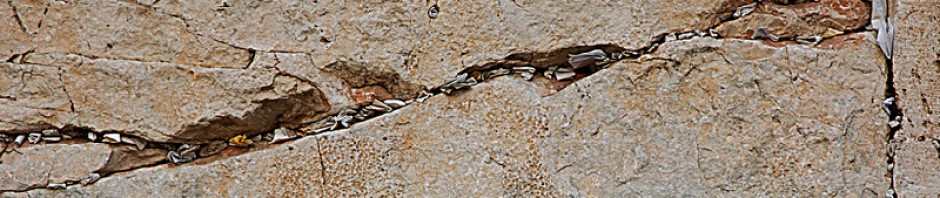
Deepest Perception Only Available in One Place

It goes without saying, M’lo Kol Ha’Aretz Kvodo, that The Creator fills the entire universe with His Presence. However, our ability as humans to experience that phenomenon is not uniformly distributed. As Jews, our ability will run much better in Eretz Yisrael, The Holy Land, than anywhere else on earth. And within Eretz Yisrael there are variations, a veritable hierarchy, as described in one of the oldest Mishnayot (early formulation of the Infinite, Oral Torah) in the fifth Mishna of the fourth Perek chapter, of Berachoth. (Berachoth, Blessings, is the first topic of the entire Talmud.) It says that if you’re riding on your donkey at the moment one can first begin to recite the Sh’ma, (The moment the edge of of the sun peeks over the horizon, illuminating the entire world),one should get off the donkey, stand next to it, facing Jerusalem, our holy city, and recite. If, however, the trail is too steep and dangerous,  or if there is no one who might be able to hold your donkey for you while you focus your heart and mind elsewhere, you should, at least, while continue riding, try to turn your head so you face Jerusalem. If the trail is too dangerous for that, you should at least “incline your heart”, focus you spiritual desire, on the Holy of Holies, that central chamber of the Beit HaMikdash, the Holy Temple, wherein resided the Ark of the Covenant, containing the God-Crafted tablets of the Ten Commandments, i.e, the most specific interface of God and Man. This same spiritual “ladder”, beginning in Eretz Yisrael, continuing to Yerushalayim, Holy Jerusalem, the Holy Temple, Bet HaMikdash, Bet Kodesh HaKadoshim, the very Holy of Holies, focusing on the space between the two Keruvim, Golden Angels molded to the Ark’s very cover.

The deepest part of this journey is not even available to the vast majority of humanity, let along of the Jewish People. Rather, on the Kohain Gadol, High Priest, is momentarily allowed inside there for the few moments it takes him to carry out the details of his sacrificial duties at the culmination of holiness during the Yom Kippur service, one time a year.

As I said, the largest portion of these holy insights and perceptions elude the vast majority of our people, of all people, even if we were fully observant, immensely learned, loving and spiritual at each moment, let alone for the rest of us…..

But one higher level of consciousness is, indeed, accessible to almost every Jew who at least sets foot in the Holy Land. I, at least, find it a recurring experience.

The Meor Eynayim, Rabbi Menachem Nachum Twerski, as talmid to the Ba’al Shem Tov, himself the founder/innovator of Chassidism, as well as the Maggid of Mezzeritch, another foundational innovator of Chassidic thought, founded the Chernobler Chassidic Dynasty and along with his emphasis on special melodies and meditations to achieve high levels of awareness and compassion, emphasized the teaching that while we all do what we do on the surface of our lives, what we’re really about is searching for those specific Holy Sparks, Netzutzot HaKodesh, exclusively relevant to our individual souls. As they were scattered about Creation, our job is to resurrect them to their highest, most appropriate place in the spiritual world. This mystical description is what traditionally we have called Tikkun Olam (in contrast to social action which might in many cases be appropriate, but doesn’t carry with it the stamp of ultimate holiness if often claims to). Rather, we assume that absolutely everything God Created in the universe is absolutely necessary for us to combine into the perfect world. Restoring those displaced sparks of pure, but too-often distorted energy, repairing them before we replace them, is a spiritualist/Kabbalistic description of how we partner with The Creator to complete His Creation into the perfect state first intended.

Anyhow, the Meor Eynaim writes that as we go about our everyday lives, wondering why we’re brought here and there, wfy we find ourselves engaged with certain people in also sorts of unexpected locales, it’s specifically because these Netzutzot specifically assigned to our souls (and thus those to which we each have the precise key) are there.

This is the phenomenon I so often experience almost every normal day in Jerusalem. When I find myself at, say a random bus stop with people I’ve never seen before, I often find myself in conversation with them, or observing their interactions with others, with the sense of great epiphany. Yes, it seems silly and pretentious to find a moment at a bus stop, at line at a cashier’s, or even in deep Torah study to have such an intense and otherwise inexplicable buzz, a sense of being in just the right place in just the exact moment…. I’ve had my own experience confirmed over the years by many friends as I talk about it with them…. It’s not so much an achievement of me and my training or accomplishments, as a product of place, the Holy Land.

Even walking four cubits in the Holy Land, we’re taught, brings us the merit of Eternal Life. Every moment is filled with opportunity.

Posted in Uncategorized | 8 Comments

One Plus One Equals One: The Same But Different, Comprising All

Increasingly, over the last twenty-five years (yes, Oslo), the Jewish Communities in Israel and those in the United States seem to have less and less in common. Burning questions in Israel concern the necessary and in-progress transformation of Halacha, and let’s remember that in addition to Jewish Law, it really means Jewish daily/weekly/monthly/yearly practice, from the Halacha of Galut (Exile/Diaspora) to a practice that which will usher in the millennia-longed-for age of Redemption.

Here we work to create the never-before-seen world-changing society, beginning with ourselves (the emphasis on individual halacha, re-calibrated for the new challenges, in order to empower and vitalize each of us to our highest potentials, but eventually inspiring others, as well, to live in perfect harmony with the deep structure of the Universe,  Ratzon HaShem, the Divine Will, the full potential of Creation.

In the Diaspora, we face an equally difficult task. How to, in rapidly changing times, guarantee the survival and continuity of the Jewish People, in what might long remain hostile circumstances. The battle is often how to fight/resist assimilation, boredom and a feeling of lack-of-purpose, just as much as it to survive violent antisemitism aimed, each generation, to wipe us off the face of the Earth

Diaspora Halacha will necessarily retain, at least to a certain degree, its “circle the wagons” style of separateness, challenging and painful as that might be when talk from Eretz Yisrael is of merging, joining together and breaking down the barriers which have kept us separate for so many generations. It seems this will be a time where boundaries will and won’t be necessary, depending on where/when you lived.

It has already become difficult, and seems likely to become ever more challenging, for our two communities to coexist, let alone to support and complement each other. For one thing, we here in Eretz Yisrael seem to project our Geula goals and values, a halachic revolution that hasn’t been prepared for there on those living in the Exile while those living in the Diaspora project their values on us, here.

In other words, the Haredi world of Chumrot (ritual stringencies in all halachic matters), a remnant of two thousand years of Galut survival actually distracts and distances us from what we should be doing. Similarly, the “progressive” priority of “Peace” at any Cost with our Muslim neighbors, shifts the focus entirely from what we, involved in the Torah and Mitzvot evolution, need to do. It ignores the very real “on-the-ground” fact that 95% of encounters here between Jews and Muslims are perfectly peaceful, pleasant and mutually productive (if only that fringe of politicians could find job=training for something less bothersome to the rest of us….). Simply, while eliminating the conflict that remains between Jews and Palestinians would be nice, we have higher priorities, as disappointing as that is experienced by many of our well-meaning brothers and sisters.

Chassidim recite a short passage from Zohar (Trumah 163-166), Kagavna, on Friday nights, just after Kabbalat Shabbat and just before Ma’ariv for Shabbat. In other words, just as we transform our reality and focus from the mundane, work-week to the elevated consciousness of Shabbat.

Before we go much farther, we need to point out a number of equivalences. As we just said, the higher realm is often associated with Shabbat, the mundane with the week. God, HaKodeshBaruchHu (or, in Armaic, Kudsho Brich Hi) with Shabbat , Am Yisrael (The Jewish People) with the week. The Jewish Community in Eretz Yisrael, Olam HaBa (the world to come), while the diaspora community(ies), to the work-week and Olam HaZeh. It’s vital to emphasize here that these do not represent rankings or value. Male is no better than female, upper than lower. Both are essential and it’s better to look at them as giving/receiving, the two “endpoints” of every relationship. As both become fully engaged and fully active, the universe approaches it’s intended state (sof ma-aseh b’machshava t’chila–the final, culminating state is identical to the goal as first conceived). Each stage along the way is absolutely needed to create the perfected world (which is our privilege as Am Segula, a chosen people, to partner with The Creator.)

Back to Kagavna, we describe the King taking his throne, the highest energies entering our “real” world of physicality and material, the merging of pure spiritual into the fully manifest, i.e. the transition to Shabbat at it’s highest experience. We learn that the mysterious Unification that takes place in the highest reaches is exactly as we unify in our realm, with One receiving One and remaining One.

Can you imagine a deeper description of all realms, for our example the current realm of Am Yisrael still living in the diaspora, trying to organize and unify and make sense of all the many contradictions within it to somehow become mutually supporting and loving itself in a way that it can possibly accept the unification with and complete love from the world of AM Yisrael, currently living in Eretz Yisrsael, in all our incompletion and imperfection, trying to discover/create/collaborate in the highest possible form of Mitzva, Mitzva from tzevet, to group or bind together.

Imagine our Friday preparation in this material world  as working to develop our Olam HaZeh to its highest level of unified harmony in order to be able to accept Olam HaBah, likewise refined to it’s highest degree, blending its perfect One with the perfect One of this world within the Absolute Perfection of The One, HaKodesh Baruch Hu. This sounds an immense improvement over merely making sure the cholent is cooking, lights set up for Shabbat and that we haven’t run out of wine.

Likewise, the goal of preserving Jewish practice in the Diaspora at this point in time might well have transformed from a defensive “circling the wagons”, a rejection of everything and everyone not already familiar (and easy), but rather beginning the process of gathering the Netzutzot HaKodesh, all those sparks of ultimate holiness which, over time, have become separated from our people but whose re-engagement is absolutely necessary to the ultimate goal. Rather than make Judaism difficult and forbidden, we need to lovingly invite the reunion and re-integration of all those who have become lost over the millennia.

Similarly, here in Israel, where, for the first time in two millennia we are both the numerical majority, but also enjoying the responsibilities and  freedom of sovereignty over our lives and land, we look forward to a Judaism, a world of Halacha and Tefilla all trying to encompass the totality of being rather than merely the shadows and foundations of what was.

Describing the Psalm we recite on Shabbat, we declare, On Shabbat they would say A Meditative Song for the Day of Shabbat, a Meditative Song for the advancing future, to a time when it is always Shabbat…..When the Universe and Everything comprising it and contained in it is unified in perfect harmony.

Posted in Uncategorized | 8 Comments

Short Thoughts As The Chaggim End For This Year

1) Avot 2:4 tells us to make God’s Will into our will, in other words,to subjugate our person agenda to God’s so that he will come to make our will His Will.

Politics, entertainment, sports and celebrities are now on a 24/7 news cycle throughout most of the world. You won’t miss anything or fall behind if you unplug for just these few days. But the experience of each Chag, Rosh Hashana, Yom Kippur, Sukkot, Simchat Torah, as they occur once each year, are once-in-a-lifetime events and opportunities.

It wasn’t that many years ago that Sandy Koufax made every American Jew(ish boy, at least) proud by refusing to pitch the first game of the World Series.

2) Of course, the Torah, in it’s perfect completeness, is never-changing. Except that it does change, especially in terms of the Oral Tradition, which is added to everything that went before each time it is learnt.

Perhaps we can, without causing too much damage, imagine a different ending to tonight’s (Simchat Torah) reading. Perhaps, instead of a tear-filled goodbye to Am Yisrael, as they prepare to enter The Land, led by Yehoshua Bin Nun, this time it’s Moshe Rabbenu himself, having never lost patience with the Jewish People and disobeyed the Creator, but who had year after year after year finally perfected himself. And we, Am Yisrael, would have followed him in, settling our land completely as it was originally intended at Creation, without the following thousands of years of war. Rather we would have brought this land, and through it, all the earth, to the Perfection The Creator originally intended.

Moadim l’Simcha

Posted in Uncategorized | 2 Comments

How Does a Sukkah Bring Happiness?

The primary Mitzvah  of Sukkot is, simply, to live inside a Sukkah for a week to eat all our meals there, to even sleep there, weather permitting, to entertain guest there and, of course, to study Torah and also, perhaps, to sign and make music, within it’s holy space.

We also commanded, separately, simply to be happy. V’samachta b’Chagecha, and you will rejoice in your festival.

This year (along with last year) marks the only two in more than forty years that I’ve not had my own Sukkah and I admit it feels strange. Of course, I can fulfill the technical requirements of eating certain food categories in the many sukkot erected by neighborhood restaurants, by welcoming neighbors, schools and synagogues and others. I’m well aware, certainly, that this is one of many “side benefits” of living in Jerusalem.

Nonetheless, I’ve spent a lot of time thinking, both this year and last, of the connection between Sukkah and Simcha (happiness). Does  the/a path to happiness necessarily travel through a Sukkah? What, of course, of the rest of the year? Does reducing the time spent in the Sukkah reduce one’s joy? Is happiness open to me at all during this week?

The fact is, however, that I’ve often found myself bursting with joy this past week, and for no real reason I can put my finger on. I’ve made no new special friends, gathered no new possessions, no new toys at all. I haven’t completed any great achievements strictly within these few specified days. I’ve probably had about my usual share of grumbles this week, certainly enough transportation and busing aggravations, but I still think if one could add up the minutes, you’d find my “smile time” significantly elevated. What could possibly be happening?

One thing, of course, is that living in Israel, living in Jerusalem, I’m surrounded by fellow Jews. But that’s no different the week of Sukkot than any other week. Of course, I’m literally surrounded by Sukkot this week, although that doesn’t mean that I’m continuously within a Sukkah, but, rather, that everywhere I look, literally, I see s Sukkah.

The Gemara, and I’m never sure of my exact references, just that I’ve “seen” it somewhere in my studies, in this case probably in Gemara Sukkot”, discusses the minimum size for a Sukkah to be kosher and says that it needs to be big enough for an average person to put his head and shoulders and part of his upper body into. It then brings us one of the most beautiful images I know within our tradition. We’re invited to imagine the entire Jewish people standing single-file in line, each one taking a turn to put his head and shoulders into this tiniest of kosher Sukkot, eating something (probably especially tasty) and saying a bracha of thanks. One-by-one, this theoretical Sukkah will contain all of Am Yisrael, the entirely of the Jewish People, each of us in a heightened awareness of The Creator.

And, perhaps, that is just the magic of a Sukkah, that each Sukkah becomes this ideal Sukkah, that every time we enter a Sukkah we surround ourselves with the entirely of the Jewish People, that every time we see a Sukkah, we see every Jew throughout our history, in all our beautiful individuality and diversity, each contributing what only we can contribute to the ultimate wholeness and integrity of God’s Created and our perfected, universe.

I can’t think of anything more joyous.

Shabbat Shalom and Moadim l’Simcha!

Posted in Uncategorized | 2 Comments

Be Happy….Or Else!

Z’man Simchateynu is upon us. Yes, it’s almost Sukkot, The Time of our Joy, and we are commanded, V’Semachta b’Chagecha V’Hayita Af Sameach! Rejoice in your festival and be especially happy.

I don’t know about you, but when “commanded” to be just about anything, my first impulse is to resist and do the opposite. How can we be expected to turn happiness on and off at command? The Torah itself has something to say about this through the rabbinic tradition to read Kohelet, Ecclesiastes, on the intermediate Shabbat of this festival, perhaps warning us, “Just not too happy”!

Traditionally, we’re supposed to be so relieved that we lived through Yom Kippur, where every living being is judged either to have yet another year to live or, chas v’shalom, to die. I’ll grant that there are some within our community of Jews who really are so holy as to deeply and intimately feel their life is on the line this time ever year, but it’s always been a stretch for me. And how does this focus on failure and destruction, just a few days ago, bring us to happiness? One would have to enter Yom Kippur, with an overwhelming sense of guilt and self-hate in order to truly feel that, sitting in the Sukkah (and this is speaking ideally in term of weather–I recently spent almost thirty years in Seattle where, ever year putting up the Sukkah was an exercise in futility because you just knew that it would start pouring rain, a storm pre-programmed to last most of the following eight days. So, in more observant circles, the men (women, while not prohibited or excluded from the Mitzvah, nevertheless aren’t commanded to eat all their meals (and possibly to sleep) in the Sukkah) would bundle up in rain gear, run through the mud in the back yard, to say a very very quick Kiddush (the inaugural blessing of the  chag), down a mouthful of wine, and run back into the warm dry house for the real festival meal. Unless you have a serious appreciation for the absurd, this ritual is unlikely to inspire you to collapse in laughter or any other expression of happiness.

I remember from many years ago Rabbi B.C.Shloime Twerski, zt”l, teaching that Simchat Yom Tov, the commandment to be happy on these festival days, to be “the hardest one in the book”. When he explained it that time, he was focusing on the requirement to not allow oneself to become even the slightest bit angry, annoyed or have any other negative emotion, for a full 24 (or 48 in the diaspora) hours. When you even briefly contemplate this, you realize what a daunting task it is!

Another theme that the Rabbi emphasized is one we recite every Shabbat  and Chag morning, “Sur meRah v’Oseh Tov” (from Psalm 34, part of the extended Psalms reading we add on those special days). It means “Turn Away From Evil And Do Good”, in other words, avoid the negative is important, but the real lesson Torah is teaching us through its many mitzvot is that the real goal is to create a positive and tangible Good in this world. So, merely avoiding anger and frustration (maybe a deep reason behind the prohibition from driving a car and Shabbat and Chag), while an essential first step, is far from the real goal.

Honestly, I wish I could wrap up this lesson with a brilliant insight on how to achieve happiness. I’d become famous and maybe even rich (would either of those suffice to make me, or anyone else, happy?). Perhaps good first step, one I’m working with on myself, is to contemplate one of the deepest concepts in Judaism, “Everything that God Creates, he Creates for His Glory/Honor”. And what could God’s “Honor” or “Glory” possibly be other than the fulfillment of His purpose in Creation, that there be a perfect world, perfected not by His arbitrary decree, but by our willing, loving participation in fixing the world through the Torah  and Mitzvot, even, or especially, the incomprehensible ones such as seeming impossible task of being truly happy.

The best I can recommend is to spend the time among people you love.

Moadim l’Simcha!

Posted in Uncategorized | 1 Comment

A Short Note To Subcribers

First, thank you for reading my thoughts for yet another year. I hope you’ll continue and that your responses will continue to inspire me.

I often find myself at the very edge of Shabbat and Holiday deadlines, and my proof-reading suffers. I don’t at all mind having my attention being brought to these mistakes and I will try to correct them as soon as I can.

Please share these essays and thoughts with your friends and colleagues. If you’re getting this, you’re already a subscriber. Please encourage others to subscribe as well. And remember, you’re honestly invited to join the conversation through the Comment section.

G’mar Chatima Tova.


Special thanks to Rabbi DA

Posted in Uncategorized | Leave a comment

Getting Ready For Yom Kippur

In many ways, Yom Kippur is the easiest of all the Jewish. No special meal to prepare, nothing to build, no difficult Megilah  to chant. Of course, in past years I would spend more than a month relearning and, hopefully, improving my chant of the entire four services, the Torah readings, the Haftorah, Yonah…. Well, that was a lot of work, especially for a non-singer like me, but if it were a “test”, it was, at least, an open-book one. The point being that even when I had to mount a “one-man show”, often leading a congregation with almost no background, when I had to provide intuitive evocations along with current content, my “job” had been done many times before and I was merely a participant in a long traditional role and I just had to plug into a pre-existing role.

The themes are ancient and have been described and discussed through the centuries. The solo performance of the Cohain Gadol, the High Priest, with his special sacrifices and once-a-year approach to and entrance into the Kodesh K’doshim, the Holy of Holies, a space/time- warp eternal center of the Universe housing the Aron HaKodesh, the Holy Ark, which contained, among other things, both the broken original and the intact copy of the Shnei Lukhot HaBrit, the two Tablets of Covenant, A physical remnant of the  Infinite Energy of God transformed into the physical/rational of simple human words carved into the very physical matter of stone, the two-way dialogue between us, as human beings and the Infinite Creator and Sustainer of the Universe, detailing our responsibilities which we pledge in exchange for the opportunity to experience life on earth.

As abstract, cosmic and all engaging as those thoughts are, in  past years l had a script to follow, one which at least included allusions to these themes. And the themes themselves, described and discussed both within the chag and in preparing my roles as leader, had become familiar, unfortunately, too often overly-familiar. Therefore as I worked to refine my understanding which was limited by this very repetition and exploration, I began to see a horizon where I would need to make several profound decisions.

Thus I find myself this year, as in the last several years, closely approaching that moment when weekday becomes, itself, Yom Kippur, a day when “all bets are off”, when we really have no idea how we will be evaluated in last years’ efforts and can only hope we’ll come out all right for the next year.

Approached this way, much of the past liturgy no longer directly addresses these issues. Albeit the comfort in these age-old melodies, the words and poetry too often no longer discuss nor lead me to where I hope to arrive, to a close and direct, intimate yet mysterious dialogue with The Creator about how I might best grow, conduct myself in this just-opening year, to add to the life energy and love of those around me, hopefully to be enhanced by theirs.

Before this day arrives, often well into it, I no longer even have the questions I need to ask. I can’t “create” the openness I’ll need to develop, can’t even imagine how any of it will feel. And as the time arrives, all I can do is enter with the  kavana, aim or intention, that somehow I’ll ask the right questions, start down the right paths to give myself, and through myself others, the first steps this next year requires.

G’Mar Chatima Tova, may our provisional beginnings lead us to that divine intimacy where all that we are called up begins to be revealed.

Posted in Uncategorized | 1 Comment

What Tshuva Can Look Like In 5779

As the calendar begins to approach a new decade–in just one year it will be 5780, as the reality of a soon-to-be majority of the world’s Jews living in Eretz Yisrael under Jewish sovereignty for the first time in almost two full millennia, as the spiritual awareness of people around the world grows more universal and compassionate (no, of course we’re not there yet, but before one arrives, one must necessarily approach), perhaps we can take a new look at Tshuva, usually (inadequately) translated as “repentance”, but perhaps better thought of as a return and a reset to our full potential as humans and as Jews.

For almost my entire life, Tshuva was presented as doing more (or, in the case of Aveyrot, misdeeds and sins, doing less).  If I learn Torah and hour a day, let’s increase it to two. If we give five dollars daily to Tzedaka (Charity), up it to six! If we’ve inspired five Talmidim, students to learn an extra hour a week, convince them to learn two extra!

And perhaps, if we haven’t this past week eaten two pounds of cheeseburger, let’s not eat three! (Of course, there is no quantification of prohibitions, and not eating treif means not eating ANY treif, but the point in this exaggeration was made many years ago by Rabbi Chaim Zimmerman, zt”l, one of my teachers in Jerusalem and considered by many to have been the Talmid Chacham most brilliant Torah scholar of his recently past generation).

I see a different direction for myself this year and in the future. As a teacher, as a rabbi, I want to encourage and enable Jews, especially those with little or no previous background, those who have been turned off by past expressions of coercion, fanaticism and intolerance, to explore and engage even just a little more this year in any side or expression of Judaism they feel comfortable and potentially at home with.

There is no One Way of engaging with and observing Torah, just as there is no One Size Fits All approach to reach out lovingly to fellow Jews (not to mention reaching out lovingly to fellow humans, but that, perhaps, is the second step). Each of us, Judaism compels us to realize, and everything God Created to make this universe, is intentional, and, as such, deeply and decisively needed to complete the final steps of our co-project with The Creator of completing and perfecting all Creation. Nothing and no one can be rejected, even if we, personally, might not see the value in them.

So, if our Tshuva can be expediting their Tshuva, even just a tiny bit, that might be the final piece that clicks into place.

Shabbat Shalom and G’mar Chatima Tova, 5779

Posted in Uncategorized | 2 Comments

The Irony Of Great Wealth

What to do? What to do? This year in Jerusalem, as Tisha B’Av, our millennia-old national day of mourning and fasting, we are drowning in a plethora of choices of how to participate.

Counter-intuitive, perhaps, certainly counter-tradition, there are any number of musical circles and workshops where we can sing together, play together, drum together, hoping to generate the sense of love and fellowship to counter the sinat chinam, unjustified hate and strife, which let to the destruction of our best interface with the Infinite Almighty and our millennia of isolation and alienation, even though we seem to contemn and ignore what had been our universal practice for these days. Maybe a new approach is necessary and, if so, there are plenty available.

We can choose, traditional chassidic, yeshivishe, zionist, peace-oriented, sufi-influenced services. We can listen to Eicha, Lamentations, chanted, or at least discussed and interpreted, in modern Ivrit, in English, French, Russian, Amharic, Arabic or Yiddish.

Mourning the “City which sits alone, after once hosting literally thousands of people”. Once the greenest, most prosperous center of culture and spirit and technology and wealth, Jerusalem is now reduced to ruins and rubble and all that remains is unending, universal sadness and  mourning….

Or is that really so? Today, in the year 5578, Jerusalem is filled with more people, including, specifically, more Jews than any time in history. We are more prosperous, living in greater comfort and luxury than ever. More Jews (as well as non-Jews), men and women, seniors and children, beginners and life-long learners, engaging and studying Torah in Yeshivot and Kollels, Synagogues and living rooms than ever before. And the unimaginable volume wisdom and insights, wise sayings and words of comfort have been digitally entered in various forms where we are able to see infinitely more connections and inter-connections that were ever available to any individual Jew. We have institutions studying the adaptation of older versions of halacha to address modern physical and social realities. We can specialize in the brilliance of the Rambam, the Holy Ari, the structure of the Shulchan Aruch and its many later researchers. There are Yeshivot devoted to Talmud, Halacha, Chassidut, Mussar, Modern Ethics, Business, Labor Relations, Relationships, Sexuality…… Everything imaginable can and is now being examined in light of our vast Torah tradition.

Or, if we want, we can sit alone, chant the ageless words of Yirmiyahu’s Eicha (Jeremiah’s Lamentations) and try to re-experience the horror and tragedy, the utter isolation, bereft of man and God, of that night when the walls were breached, the Holy Temple set ablaze, our brothers and sisters, parents and children, indiscriminately slaughtered.

Yes, we have an almost limitless menu set for us, inviting each of us in our own way to participate not merely in commemorating the tragedy, but participating in the (hopefully) swiftly-approaching  complete redemption.

It seems to me that the important thing is that no matter which style of observance we adopt this year, and hopefully this is our final year of effort, we do it in a spirit of Ahavat Chinam, unprovoked love for each other, for our Creator, for fellow Jews and for all mankind, in such a way that next year it will, indeed, appear that this year, with all it’s progress and achievements, was still desolate compared to our ultimate potential.

Posted in Uncategorized | 4 Comments

A Challenge To The Rabbanut, The 3-Weeks, 5778

There’s a concept in civil law called Relief. The idea is that when someone suffers damages they should be compensated, as best as can, at least partly, for their losses. Ideally, the one who caused or profited by the damages should be the one makes it good. However, that’s not always possible and often, as we move in time away from the original injury, it’s harder and harder to determine guilt. Also, as time goes on, one who caused the damages might no longer be in a position to recompense the original victim or to return the situation to what it was earlier. In actual law suits, one might need decide who, in the present, can offer the best solution even if he had nothing to do with the original damage. One often finds a situation where the original villain, even when he willingly admits his guilt and even his desire to “make things right” is in no position to and must then walk away free. In other words, it’s very rare that one can actually put the toothpaste back into the tube and completely undo the damage that has been done.

Our early sages, responding the destruction of Jerusalem and the Holy Temple, leading to our 2,000-year-and-continuing (hopefully coming to an end as we live in the era of Kibbutz Galyot, the (in)gathering of the Exiles), associated these tragedies with several other national disasters that occurred generally during these months and instituted a number of rituals not so much to “commemorate”, these Divine Punishments, but to actively get each of us started on our personal and communal Tshuva, Roads to Return.

Spread throughout the world, for the most part as, largely, powerless minorities, our sages innovated communal fasting and quasi-mourning, activities unlikely to call too much attention to ourselves. We needed, it was assumed, to keep our heads down. Based on the idea that The Creator would have punished us all only if He were mightily provoked by our behavior, combined with our holy awareness that we eat and are otherwise rewarded by The Creator only when we’re not making things worse, communal fasting was, at those time and in those situations, seemed an appropriate and, perhaps an effective tikkun (a repair of in the spiritual realm, where the root of most problems can be found and addressed). Also, we could quietly, wherever our communities were found, try to express our remorse and hopes to change without antagonizing our often hostile neighbors. Needing to keep our heads down, what better format than early morning and late night prayers and study?

Nonetheless, I can’t help notice that the reasons for our long galut, exile, never included overeating or even ignoring the laws of kashrut. Fasting and refraining from joy may well help us focus our attention on those things we did do wrong, but beyond that it’s hard for me to see what one thing has to do with the other. (Of course, I accept the rabbinic teaching that when Chazal offers us a reason for deep reality, they pass over in silence ten other (presumably more profound and subtle) equally or more valid reasons.)

Nonetheless, it seems that the avenue of relief afforded us has little to with returning us to “God’s Favor”, restoring our position in Eretz Yisrael and performing deeds and actions, where acting as Or L’Goyim, a Light to the Nations, we help lead not just the Jewish People, but all Creation. In other words, “what does “A” have to do with “B”? More important, is there an “A'” which might be more directly, or at least obviously lined, to “B”?

No longer needing Halacha to be so “defensive”, to protect us from our pain of always being The Other and our subsequent desires to remove all boundaries, perhaps at this point in our history we no longer need to worry so much about keeping our heads down, our profile low. At least those of us living in Eretz Yisrael can direct our desires to conform to conform to the dominant culture of Eretz Yisrael!

For example, I’d like to propose that, organized and presented by the Haredi communities, a series of sing-along concerts throughout the country. With the various “ultra-orthodox” opening their doors and inviting their less observant brothers and sisters into their world to share a joyous occasion, both reminds us of the fault (forgetting that we are actually brothers and sisters) which led to the Exile itself and directly undo the damage we wrought with our narrow intolerance towards large percentages of our very own people, that very Sinat Chinam that underlies all these tragedies we’ve endured and are enduring.
Not to let the “progressive” wing of our people off scot-free, there has long been an equal blast of sinat chinam towards the charedim and others condemned for being outmoded, It might be nice to see their rabbis and organizations reaching out to orthodox and charedi rabbis and communities to share some of their insights, inspiring rituals. It would benefit many the progressive Jew to discover and experience the architectural magnificence developed in centuries of ongoing talmudic study, of the ultimate development of inferential reasoning, all aimed not at some abstract concept of “truth”, but at justice and compassion, even when these goals require repudiating the philosophical in favor of the humanistic. It would amaze many in both camps to see the tremendous amount of shared values, principles and, at least in their origins, ritual. We are, after all one family, albeit outspread and complex.

Perhaps we can reach a point where it’s less important where the teaching or prayer came from, but how effective it is now in bringing us to a closer relationship, a deeper understanding, a more transformational experience of God. Where if fasting has any value at all, it’s to remind ourselves and our Creator that we acknowledge past error and dedicate ourselves, communally as well as individually, to be more welcoming of the other, the insights and experiences we’ll never personally have, but which are necessary to create a full view of what sort of society we ca create and sustain. If that’s not a good working definition of Ahavat Chinam, perhaps it’s the very next step once we’ve, hopefully, achieved it.

Posted in Uncategorized | 5 Comments